

visiting exhibitions about masculinity
Curators get particulary into curating curations about masculinity

As a valued member of my erudite readership, you are well aware that I’m quite a well-rounded culture connoisseur. It’s why you’re here, it’s why I write. I go to far and obscure places to find the next big thing. That means I’ve recently travelled to both Brussels and Den Bosch for two interesting art exhibitions about gender and masculinity.
Let’s start in Brussels. Curators Géraldine Barbery and Audrey Lasserre went through the collection of the Royal Museums of Fine Arts of Belgium to focus on gender stereotypes in artistic representation. That made the set-up quite interesting, because instead of going to a special wing of the museum for the selection, you follow general visitors through the permanent collection, but with a fun little sidequest.
This put emphasis on the fact that most of our knowledge and assumptions about art are based on gender stereotypes. This treasure hunt is divided in 16 subthemes like heteronormative couplings, female artists, fetishized bodies, different gazes and masculinities.
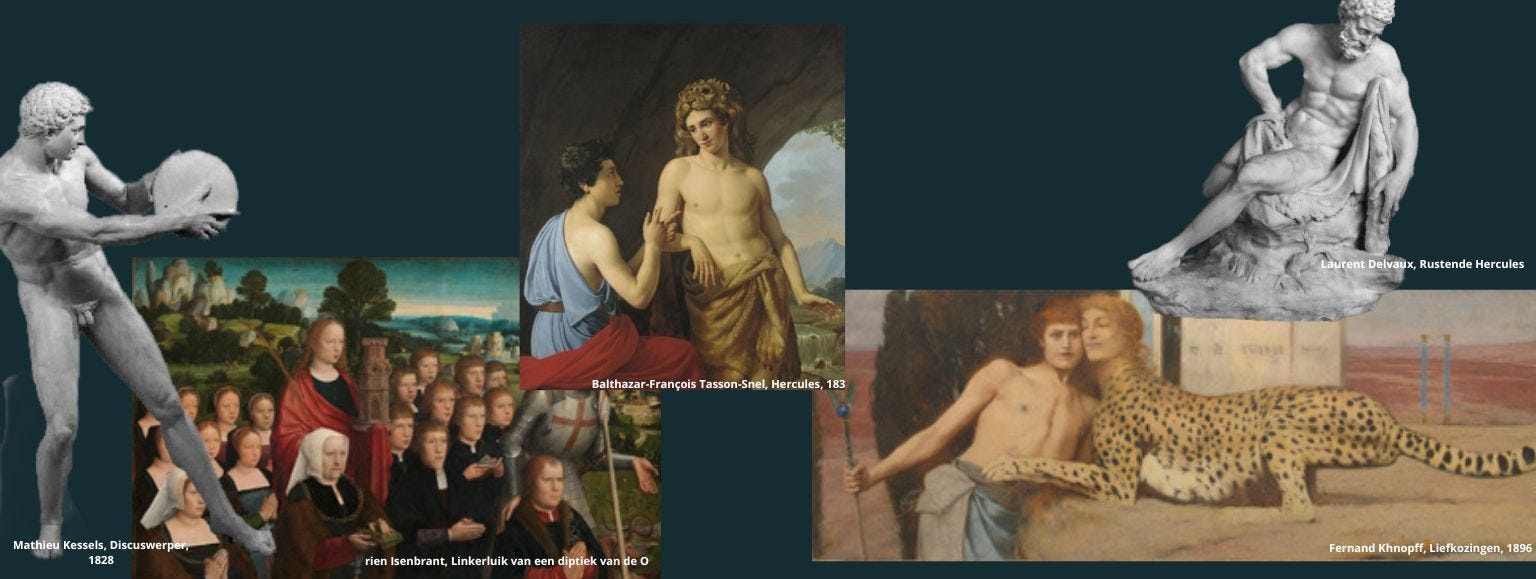
In the latter the idea of ‘hegemonic masculinity’ by sociologist Raewyn Connell is central, where men reject everything that’s perceived as feminine and stigmatise homosexuality. The curators then show us examples of how this idea is examined. A Hercules by Laurent Delvaux that still has the body of a hero, but put in a tired and contemplating position. There are also a lot, truly a lot, of pairings that are ambiguous either in the relationship of the same-sex sitters or the gender of them.
Then I was off to Den Bosch, which from now on is much more than the hometown of Jheronimus Bosch and the Bossche Bol (a concoction of dough, chocolate and a shitload of whipped cream) to me. It’s also where Het Noordbrabants Museum is, who currently have a very clever show on masculinity.
Although the show is called ‘Am I masculine?’ guest curator Roberto Luis Martins doesn’t seem too eager to answer questions about masculinities, but poses exactly the right questions.
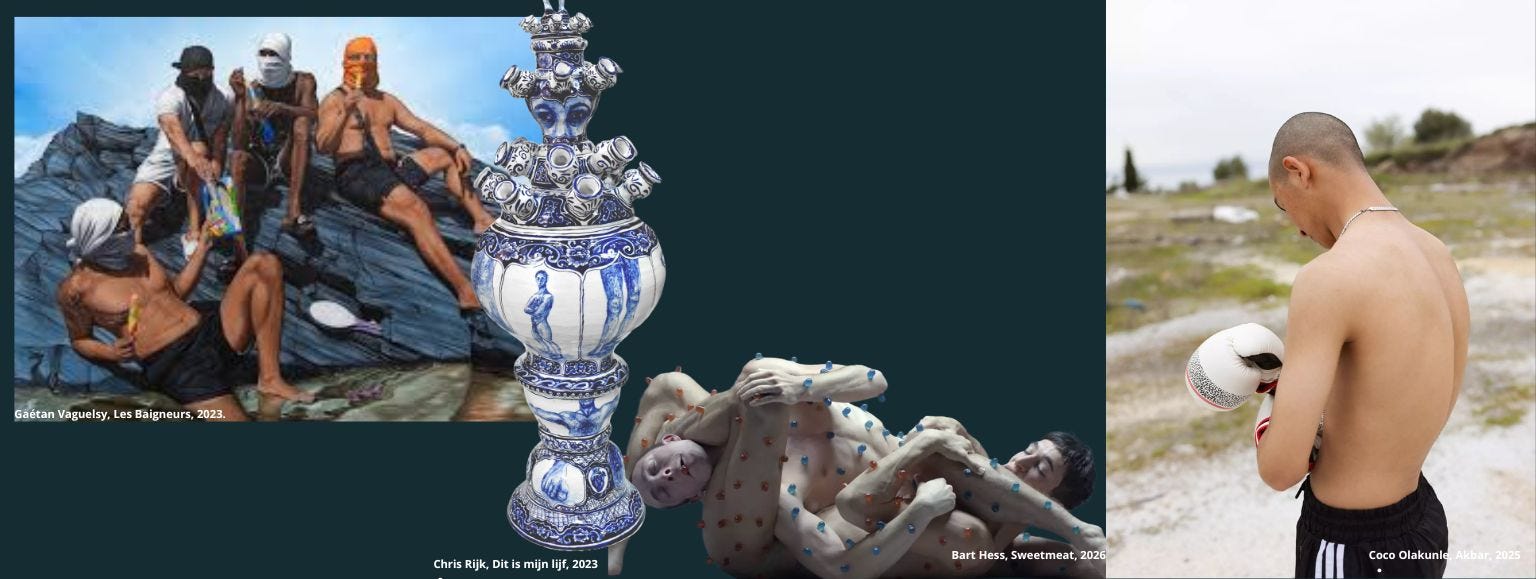
It’s a vast exhibition (maybe a bit too much, so make sure you have enough time) What stuck most is the focus on how masculinity, often represented by a phallic metaphor, can be shifted to other objects. Obviously an erect penis represents masculinity, power and force and it’s not a reach to project that onto muscular, big bodies and confident presence. I loved the reading into the subtler ways of shifting that metaphor for masculinity. A Gucci hat to show your financial power or guns and heavy machinery to show strength.
Our guide of the day, professor of literature Ernst van Alphen, came back to the subject of the butt a few times. In a painting by Gaétan Vaguelsy where we see 4 friends eating popsicles on a rock. Their identities are covered as much as their private parts. Professor Van Alphen notes that their choice for oversized swim trunks, a modesty straight men cling to, suggests a certain discomfort with their butts being gazed upon, while gay guys are more willing to show what they’ve got. This straight guy discomfort is endlessly ironic when contrasted with their own unapologetic gaze toward women.
In the same painting there are a couple of subtle and obvious examples of shifting characteristics of masculinity. Their faces are covered and there is no erection in sight. Their bodies are clearly doing the talking about their strength and that popsicle has quite a suggestive shape.
Both exhibitions take refreshing steps to challenge ideas about masculinity and show that it is less of a fixed identity and more of a carefully constructed performance. Whether it’s through a tired Hercules or a suggestive popsicle, the hegemony of it all is showing cracks. And honestly? It’s about time we all started looking a bit closer at what’s behind the swim trunks.